Getting Your Equipment Ready for a Dredging Project
 By
Dave McCracken By
Dave McCracken
Proper preparation at the beginning of a dredging project helps to avoid costly
problems and/or delays.
Our preparations actually begin at the end of the previous season or project,
when we carefully clean all the gear before storing it in a safe, dry place over
the winter or during the rainy season. Proper “winterizing” includes: (1)
running all of the fuel out of the carburetor; (2) emptying the fuel from the
gas tank; and (3) spraying some oil into the motor-cylinders to make sure the
motor does not seize up while in storage.
Our “start up” routine in preparation for a mining project usually includes the
following:
Engine and Pump: We always replace the spark plug, motor oil and filter, fuel
filter, points, condenser, and air filter at the beginning of every season. We
also take a hard look at the distributor cap, spark-plug wires, ignition switch
and other wiring. Anything that looks questionable is immediately replaced.
 Next, we pull the pump impeller to make sure (1) it is not worn or damaged, and
(2) that no foreign material is lodged inside. Then, we grease the bearings and
check the pump seal, replacing either if they don’t look perfect. When doing
this, always remember that you should not touch the rubber of the pump seal with
your bare fingers. Next, we pull the pump impeller to make sure (1) it is not worn or damaged, and
(2) that no foreign material is lodged inside. Then, we grease the bearings and
check the pump seal, replacing either if they don’t look perfect. When doing
this, always remember that you should not touch the rubber of the pump seal with
your bare fingers.
Once the motor and pump have been fully serviced, we test them to make sure
everything works properly before hauling the dredge down to the river. Note: You
should not operate a dredge pump for very long without water passing through the
pump. The water being pumped keeps the pump seal from overheating. If your motor
test will take very long, you might want to use a garden hose to direct a flow
of water into the intake-side of the pump.
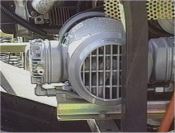 Air-Breathing System: All of the air compressors I have seen on gold dredges are
equipped with reed valves. These are stainless steel, flex-plates that allow air
to flow only one way through a chamber. These reed valves need to be cleaned,
polished, and straightened at the beginning of every season. Be careful to pay
close attention how things come apart, so you can put them back together the
right way. It is easy to make a mistake on some of the more complex compressors! Air-Breathing System: All of the air compressors I have seen on gold dredges are
equipped with reed valves. These are stainless steel, flex-plates that allow air
to flow only one way through a chamber. These reed valves need to be cleaned,
polished, and straightened at the beginning of every season. Be careful to pay
close attention how things come apart, so you can put them back together the
right way. It is easy to make a mistake on some of the more complex compressors!
Some compressors have rubber diaphragms, and some have piston rings. These
should be checked and replaced, if necessary. Rebuild-kits are generally
available for each type of compressor. You can usually pick one up from your
local equipment dealer.
We always open up our regulators at the beginning of a season and blow them out
with compressed air. Be sure to check to see that there are no holes in the
regulator rubber diaphragms, and that the rubber exhaust seals are working
properly. This inspection will require you to open the regulator and look
inside. If you ever have problems with water getting inside your regulator while
you are diving, it is nearly always caused by a worn-out rubber exhaust valve.
These are easy to obtain and replace.
It is especially important to open up and clean any check-valves in the air
system. They have a small spring and ball-bearing inside that can get dirty and
begin sticking if you don’t clean them once in awhile. Note: There should be a
check-valve on the exhaust-side of each compressor, attached to the compressor
itself. This is designed to prevent loss of air pressure, through reed-valve
leakage, when the motor is shut down or at idle. They have a small spring and ball-bearing inside that can get dirty and
begin sticking if you don’t clean them once in awhile. Note: There should be a
check-valve on the exhaust-side of each compressor, attached to the compressor
itself. This is designed to prevent loss of air pressure, through reed-valve
leakage, when the motor is shut down or at idle.
We always soak our air-lines and regulators in a mild bleach-water solution for
about half a day. Let the air-line sink in a tub of this solution, or pump it
inside, so the bleach can kill any fungus that has grown inside. This
disinfecting will help you to avoid potential respiratory problems later from
the fungus. The line and regulator should be thoroughly rinsed with fresh water
afterwards, and then blown out with compressed air.
Before placing these into service, We check all of the air lines and fittings to
make sure everything is working properly—no leaks and nothing that looks like a
potential problem.
We also thoroughly clean the air-reserve tank and make sure it contains no rust,
fungus, or anything else that could potentially cause problems.

Dredge: We thoroughly inspect the sluice boxes, screens, riffles, dredge frame,
and the jet(s) to make sure there are no holes, cracks, or any other structural
problems. If anything even looks like it could become a problem, it should be
fixed on the spot. While the gear is in a place where it is easy to fix, all
repairs and adjustments should be made now to prepare it for the entire season
or project. The goal is to take corrective actions at the beginning, for the
purpose of avoiding more serious problems or costly downtime after the project
gets started.
We thoroughly scrub all of the steel with a good wire brush and follow up with a
fresh coat of primer and paint at the beginning of every mining season. It’s
nice to start off each season looking good!
Be sure to carefully inspect all of your rope and cut out all of the weak areas.
Splice or melt all frayed ends, and throw away any old, worn-out rope.
Floatation: We always take a close look at the pontoons to make sure they are
structurally-sound. If any defects are found, we repair or replace them, as
necessary.
Suction and pressure hoses: All of the hoses should be visually inspected
carefully before the beginning of any project. It is not uncommon to completely
replace all of the pressure hoses. Any holes or kinks in the suction hose must
be cut out. If this corrective action makes the suction hose shorter than it
should be, we order another one.
 Diving Gear: We go through all of our diving gear, replacing anything that is
worn out. Wet-suits get fresh patches where needed. You don’t want to be any
colder than necessary during the early spring! Diving Gear: We go through all of our diving gear, replacing anything that is
worn out. Wet-suits get fresh patches where needed. You don’t want to be any
colder than necessary during the early spring!
Tools: We go through all the tools, cleaning and oiling them, as necessary.
Missing tools are replaced so we can begin the season with a full set.
Underwater tools and pry bars get a fresh coat of bright paint so they can be
seen in the work-area more easily.
There is a common saying among dredgers that “Murphy was a miner!”
Murphy’s Law:
“Anything that can go wrong, will go wrong.” This statement is especially true
for any dredger who begins a project without carefully checking and servicing
all his gear.
|