By Dave McCracken
It is nearly always important for a prospector to target his or her sampling efforts to reach the bottom of hard-packed streambeds.
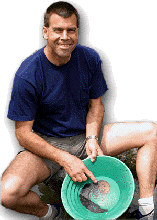
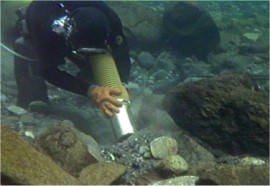 Successful mining in streambeds is generally accomplished in two steps: (1) prospecting and (2) production. This is true on any scale of operation. First, you need to find a gold deposit, usually a pay-streak. Once the deposit is located, then you can concentrate on a production program to recover the gold from the deposit.
Prospecting generally consists of digging or dredging sample-holes in different locations, then comparing the results of the different samples. Through trial and error, the positive signs are then followed into high-grade gold deposits.
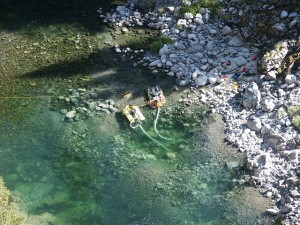
In a waterway, the first effort should be to locate the common path along which most of the gold typically travels. Sampling is then performed along that path to find the pay-streaks. This system is thoroughly outlined in Gold Mining in the 21st Century, and Part 1 of Advanced Dredging Techniques.
The following video clip also demonstrates this very important principle:
When you are sampling, you should nearly always be looking for hard-packed streambed material. “Hard-pack” is created at the bottom of waterways during major flood-storms.
Generally, a winter storm, even a large winter storm, will not create enough turbulence and force within a river, creek or stream to redeposit the compacted streambeds that are already in place along the bottom.
Flood-storms of the magnitude to redeposit streambeds do not occur very often.
For example, on the Klamath River in northern California, where my own team dredging operations take place during the summer months, we believe the last time that a substantial amount of hard-packed streambed was formed was during the 1997 flood. An even larger storm took place in 1964. In many places, a 1964 flood-layer was laid down on top of a much older, harder-packed, virgin streambed — one formed perhaps thousands of years ago.
To give you an idea of the magnitude of storm that it takes to create hard-packed stream-beds, take a look at the following video sequence I captured just down river from Happy Camp during the flood of 1997:
So, it takes a major flood storm to move and lay down a hard-packed streambed. And, it takes a super-sized major flood storm to create enough force and turbulence in a river to break up ancient streambeds and redeposit them as newer hard-packed streambeds along the course of the waterway. This happens only very rarely.
The reason that hard-pack is important to a prospector is because gold nearly always concentrates at the bottom of hard-packed, flood layers. Therefore, it is nearly always important for a prospector to target his or her sampling efforts to reach the bottom of hard-packed streambeds.
The following video sequence shows exactly what hard-pack looks like. I captured this video during a Group Mining Project in a location where we were recovering a rich gold deposit from the bottom of an ancient streambed layer resting on bedrock:
Gold is about six times heavier, by volume, than the average weight of the sand, silt, and rocks that make up an average streambed. Because of this disparity in weight, when streambed material is being washed downriver during a major flood-storm, most of the gold will quickly work its way down to the bottom of the streambed material that is being carried along by the raging flood waters.
In the following video segment, watch how fast the gold penetrates average streambed material once it is placed into suspension. The second video segment provides a visual demonstration of this very important point:
Because the gold is so much heavier, it will work its way down along the river-channel more slowly than the other streambed materials. During major flood-storms, most of the gold moving in a waterway will be washed down across the bedrock, or across the surface of hard-packed streambed that is not being moved by the storm. At some point during the storm, gold becomes trapped out of the turbulent flow by dropping into irregularities, cracks and holes that are present along the surface over which it is traveling.
As shown in the following video segment, other heavy materials, like lead and old iron objects, also travel and deposit in the same places as gold. These other materials can sometimes lead you right into a rich gold deposit:
Because of its enormous weight, gold also deposits much earlier during the course of the storm than the streambed material which eventually seats itself on top of a pay-streak. As the storm begins to taper off, and the water-forces begin to slow down, particles of gold will start dropping out of the flow. Along the path where most of the gold is traveling in the waterway, traces will be deposited, with more substantial pay-streaks forming within the larger, low-velocity areas. These gold deposits are being laid down even as the (much-lighter) rocks and gravel are still being washed down river with the storm flows. Streambeds form later in the storm, when the water-turbulence tapers off enough to allow the rocks, gravel, sand and silt to drop out of the flow and form a seated bed along the bottom (over top of the gold).
Streambed material that lies in on top of a pay-streak will nearly always be hard-packed. The reason for this is that if there is enough force and turbulence to move substantial amounts of gold in the waterway, then there is also enough force to create a naturally-formed streambed on top of the gold as the same storm tapers off.
How do natural streambeds form? First, the storm needs to be powerful enough to rip up the streambed material, put it into suspension, and wash it down the waterway. This process is similar to gravel washing through a sluice box, only on a much larger scale. During the later course of the storm, as the water-force and turbulence starts slowing down, natural obstructions or traps along the river-bottom will allow certain key rocks to become lodged or seated. An example might be a flat rock that drops into a bedrock indentation, with the forward edge of the rock pointing slightly downward into the flow. The water-current then holds the rock to the bottom. With this rock in place, new locations are formed for other rocks to become lodged. Smaller rocks, sand, gravel, and silt will fill every gap and crevice in a manner similar to the mortar used to cement layers of brick. More rocks then fall into place. More filler then packs the spaces created between the rocks, and the bed forms.
Hard-packed streambeds form mostly with the flat rocks lying horizontally and slightly tipped downward against the direction of the current. The way in which streambeds form during major flood storms leaves the bed-material seated and compacted together, much like a mechanical structure. In dredging, we call this structure “hard-pack.” Most of the gold in present waterways is covered over by hard-packed streambed. So it is very important to know what it is. The following video segment shows you exactly what to look for:
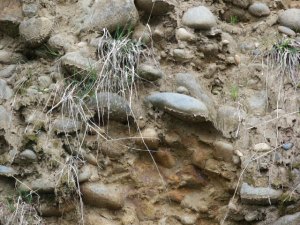
For substantial amounts of gold to move within a waterway, it requires a major flood-storm with enough power to blast up some of the pre-existing hard-packed streambeds. This is because most of the existing gold in the waterway is trapped below existing hard-packed streambeds.
It is the abrasive action of the streambed material (more like a huge band-saw), as it is being washed down along the bedrock during major flood-storms, that causes bedrock channels to cut deeper into the earth over geologic time. When such a storm tapers off, new hard-packed streambeds will form over top of the gold deposits.
“Loose-packed” material consists of sand, silt, rocks and gravel which possess little or no natural structural cohesiveness. When you dredge a hole down through loose streambed material, it keeps sliding in on you. Digging through loose-pack can be like trying to dig down through a pile of sand or gravel. The material keeps slipping into the hole. This makes for a much more difficult sample hole if the material runs deep.
Sometimes, loose material is resting on top of a hard-packed streambed and must be moved out of the way first, before the hard-pack can be properly sampled.
When you dredge a test hole through hard-pack, the streambed will generally hold up the wall surrounding the hole. In fact, many of the old-time operations tunneled underneath hard-pack. This was/is called “drift mining.” Sometimes they even tunneled directly under active rivers!
It is also important to be able to identify tailings. Tailings are easy to identify, as long as you understand how streambeds are mined. Tailings do not look either like hard-pack or loose streambed material.
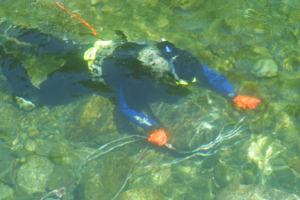 When hard-packed streambed is being mined, the cobbles and boulders (i.e., rocks that are too large to pass through the recovery system) are tossed back onto a pile behind the production area. As the production area moves forward, piles of boulders and cobbles are left behind in place of the original hard-packed streambed. Sometimes, sand, silt and gravel that is processed through the recovery system is dropped on top of the cobbles. Later, winter storms also wash sand, silt and gravel across the top of the cobbles. The sand, silt and light gravel then filters down and fills in most of the space between the cobbles. Therefore, tailings usually end up as loose stacks of cobbles with sand, silt or light gravel filling the spaces.
A large flood-storm may wash the tailing-cobbles away at a later time and redeposit them into a newly-formed hard-packed streambed. Or, as in the case of the 1964 flood in northern California, rather than wash away all of the cobbles, many of the piles were leveled off by the storm, and a new layer of hard-packed streambed was deposited directly on top of the loose cobbles. When we dredge sample holes in those locations, we usually find a hard-packed streambed on top of the tailings (loose cobbles). If gold traveled in that part of the waterway, we find it concentrated at the bottom of the hard-pack, sitting on top of the tailings. Underneath, we find loose cobbles with sand and silt between them. These usually go all the way to bedrock. We find very little gold on bedrock, because it has not yet been directly exposed to a major flood storm since being mined.
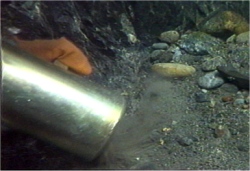
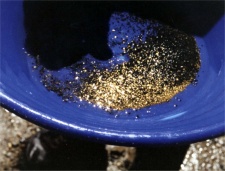
Some waterways will have several different natural streambed layers, each with its own concentration of gold resting on top of the layer or bedrock below. Different streambed layers usually exhibit a different color and compactness. The “contact-zone” between the layers is generally pretty easy to spot. Within the contact zones between layers, and on top of bedrock, is where you will find most of the gold concentrations. Those areas, then, should be the target of your sample holes.
As shown in this following video segment, sometimes the highest-grade deposits will be found up on top of a layer of hard-pack in the streambed:
Seldom will you find rich pay-streak gold deposits associated with loose streambed material. However, it does occasionally happen. These occurrences are almost always the result of winter storms, and the resulting run-off, eroding away a hard-packed streambed along the bank — which washes the gold down into the waterway to rest with the loose material.
There are areas in Africa where streambeds consist entirely of loose gravels – sometimes which carry substantial amounts of gold and/or gemstones. But this is an exception to the rule.
Effective sampling is the key to a successful mining operation. And, when you are sampling, you should be looking for hard-packed streambed layers. Watch for the gold concentrations along the bottom of these layers, because that is where you will usually find them.

- Here is where you can buy a sample of natural gold.
- Here is where you can buy Gold Prospecting Equipment & Supplies.
- Books & Videos by this Author
- More Gold Mining Adventures
- Logistical Planning
- More About Suction dredging
- Schedule of Events