By Dave McCracken
Given your available resources, what are you trying to accomplish in the time allowed on this project?

Knowing what to do in gold prospecting is only the first step. Beyond that, you must actually apply your knowledge to real life situations in the field. The inability to properly apply mining knowledge in the field is the primary cause of unsuccessful gold prospecting operations.
I have talked with prospectors who knew exactly where the sample holes should have been dug or dredged. They could even point out the specific places and give the reasons why. But, for various reasons, the holes were never dredged, or the sampling plan was abandoned before it was completed. Their failures were not necessarily due to a lack of willingness to work. Some of those guys were doing plenty of physical work every day! But, they just did not seem to be able to channel their work-energy into those areas that were really essential to get them into gold. They could not stay on track!
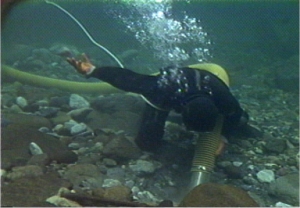 This is not only a matter of following through with a single plan. Sometimes, people are unwilling to depart from some course of action once they get started into it. Sampling requires more emotional flexibility than this. Many times, we are just guessing, or hoping, when we begin a sampling operation. Then, as we sink our sample holes, if we are paying attention, we learn more about the area and are able to adjust our sampling plan accordingly. We learn where the gold path (the highway that gold follows in the waterway) is more likely to be by finding out where it isn’t. We find out that the streambed is too deep in some sections of the river by dredging test holes in places where we can’t reach the bottom. We have to be prepared to adjust our sample plan each time we learn something new.
A lot of this comes back to identifying and taking the proper approach. This process begins with the fundamental question: What am I trying to accomplish in the time allowed to me on this project? And the second key question: Given my available resources, how is the best way for me to accomplish that? If you answer these questions with integrity, and then direct your activities accordingly, you will be on the right track.
 Sampling technology is easy. Gold follows a path in the waterway and deposits at the bottom of hard-packed streambed layers. You find the deposits by first completing sample holes across the waterway to establish where (laterally) the gold path is located, and in what layer (depth) of the streambed it is found. Then, you sample down to the depth of that layer, along that path, until you find the deposit you are looking for. That is the essence of sampling technology, wrapped up in the last three sentences.
So what makes it difficult to apply? It’s the internal, emotional struggle involved in not knowing where the gold is. It’s easy to get discouraged after working hard to complete several test holes in a given area and not finding what you are ultimately looking for. Discouragement can override a person’s willingness to stick with a sampling plan. People give up on areas that have not yet been properly sampled. Negative emotions can obscure your recognition of positive signs. We all struggle with this. In fact, this is the main struggle you have to overcome in gold prospecting.
Sometimes, only small traces are the first sign that a gold deposit is near. These small traces of gold are exactly what we are looking for! We must then follow these traces to see where they lead. So we cannot allow our own personal discouragement distract us from looking for the small signs that lead us into the high-grade gold deposits.
 Stop and think about this for a moment: If we already knew where the gold was, we would not have to sample. We could just go into production! But, if it were that easy, someone else would have already taken all the gold. The reason there is so much gold remaining in today’s waterways is because it is not visible. And, since no one can see it, most people believe it is not there.
In view of the fact that you don’t know where the gold is when you start sampling (or even know that it is there at all), your real personal challenge is to diligently adhere to your sampling plan, while watching very closely for the signs that will direct your search to those places in the waterway where the deposits are most likely to be found. This, in essence, is the game you are playing in prospecting. It is a game to stay ahead of your own discouragement.
The knowledge about what to look for is secondary to your willingness to apply yourself to the task of recognizing the positive signals when they are there. Your success depends directly upon what you do with the information you receive from your samples. These decisions are made internally. To make them correctly requires focus and discipline.
 I often see people get discouraged when they fail to find a rich gold deposit in the first sample hole. We all experience this to some extent. But, this happens only because we have allowed ourselves to set unreasonably-high expectations. The sampling process is never about a single sample hole. Rather, it requires us to spread out across a waterway to find the “gold path,” no matter how many sample holes that may take. That’s the mission. Sometimes it takes 4 or 5 samples. Sometimes it takes more. How can you expect to guess it right on the first try? Isn’t that an unfair and unrealistic expectation?
It is better to view sampling as a quest to find and follow the gold trail up into the deposits, instead of just dredging a sample hole, or even a series of sample holes. What are we trying to do? Find a deposit, right? So, our job is not to simply put down a sample hole. It’s about finding and following a trail. This is what you need to be thinking about. This is the wavelength you need to dial into. 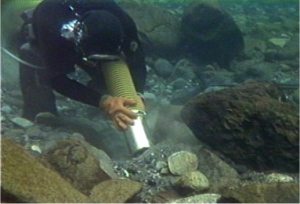 Then, your focus will be where it belongs.
Don’t allow yourself to get too discouraged if a sample hole does not turn up a rich deposit. Instead, feel good about finishing one step in the series of steps necessary to track down a gold deposit. Analyze what you have learned from the sample. Consider how this new information should affect the way you proceed in your overall sampling program.
Can you see why personal application is the key to success or failure? No matter how much you know, if you are not out there actively, passionately, diligently sniffing out the path that gold follows as it lays down deposits in the waterway, you are not going to find very much, unless you are just plain lucky.
Consistent success depends on applying the right basic approach.
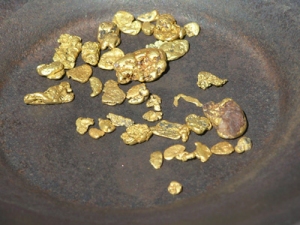
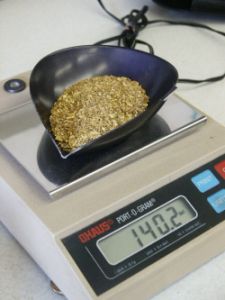
- Here is where you can buy a sample of natural gold.
- Here is where you can buy Gold Prospecting Equipment & Supplies.
- More About Gold Prospecting
- More Gold Mining Adventures
- Schedule of Events
- Best-selling Books & DVD’s on this Subject